Configure agents
Define reusable agents in a workspace — model, system prompt, tools, and optional memory. Config only; nothing runs until you dispatch.
View docsDispatch runs. Route to metal GPU nodes when available, fall back honestly, and keep an immutable cryptographic receipt.
NewTransparent Routing Protocol v0.1Integrates natively with leading AI models & agent frameworks
Purpose-built for modern agentic workloads with transparent routing at its core, RunLayer sets a new standard for metal execution, honest fallback, and verifiable receipts.
RunLayer is shaped by the real reliability demands of agent developers: fast router dispatch, honest fallback, and zero silent degradation.
Connect decentralized provider machines directly. Verified RTX 4090s and H100 clusters execute inference over authenticated WebSocket channels.
Sub-millisecond route resolution with verifiable cryptographic receipts. Generates auditable SHA-256 proofs without adding execution latency.
RunLayer is the relay from agent definition to verified completion — dispatch runs, route to community metal when it's online, fall back with disclosure, and keep a receipt on every finish.
Define reusable agents in a workspace — model, system prompt, tools, and optional memory. Config only; nothing runs until you dispatch.
View docsYour app or the console sends a run with agent_id and input. The orchestrator authenticates, checks caps, and queues execution.
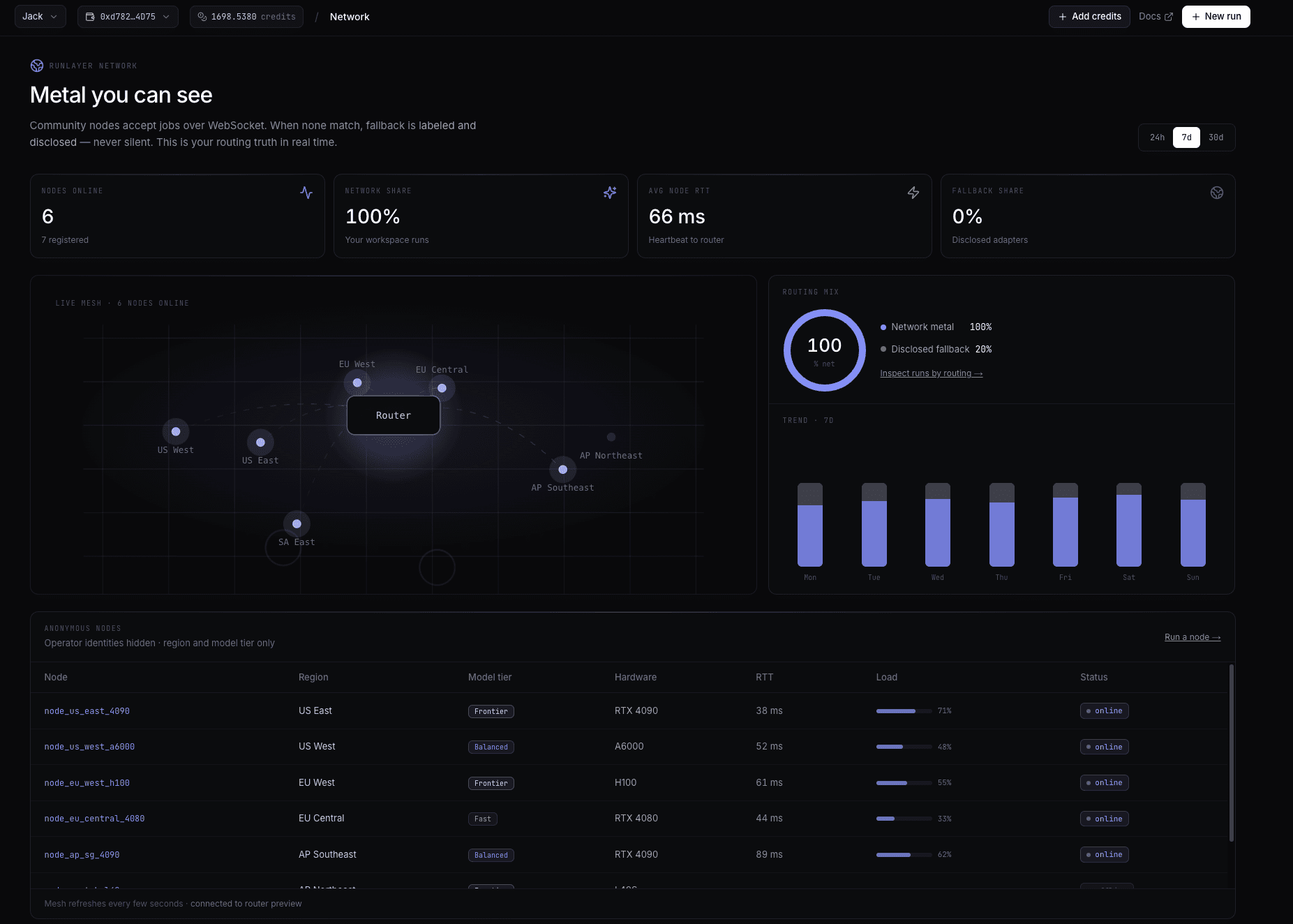
View docsThe router assigns online GPU nodes when model and region match. Otherwise a disclosed fallback completes the run — never silent.
View docsEvery completed run returns output, token usage, receipt_id, and routing metadata so integrators can audit what actually executed.
View docsWe are a team of engineers who love building tools for other engineers. Our goal is to create the agent execution platform we've always wished we had — one that just works.
Simulate agent runs and exercise the routing API without dispatching untracked workloads to production metal.
Learn moreReceive real-time notifications when runs complete, route to metal, fall back with disclosure, or issue a receipt.
Learn moreEvery finished run includes routing metadata — network node id, region, and latency, or a labeled fallback. No silent off-network execution.
Integrators get a stable receipt_id with usage and routing source for support, billing disputes, and internal audit trails.
Issue scoped keys (rl_sk_…) per project. Your backend calls RunLayer; end users never need to see the console.
Store model tier, system prompt, tool policy, and optional memory as config — materialized into a run only when you dispatch.
Operators run runlayer-node on metal. When a node matches model and region, the orchestrator assigns work over WebSocket.
If no suitable node is online, configured adapters complete the run with disclosed fallback in the API and console.
POST /v1/runs and GET /v1/runs/:id are the core contract. Playground chat is one preset agent — production stays API-driven.
Track prompt and completion tokens per run. Spend caps per workspace and API key land in v1; design for limits from day one.
Stablecoin settlement, x402 pay-per-run, and optional on-chain receipt anchors are on the roadmap — not the v0 launch blocker.
The console is built for builders — inspect runs, read routing truth, manage agents and keys, and debug production workloads without treating chat as the product.
Every run in one place
Filter by agent, status, and routing type. Open a run to see input, output, token usage, receipt_id, and whether execution used network metal or disclosed fallback.